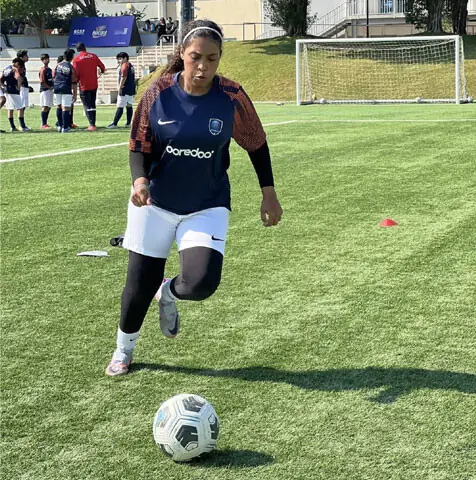
In the crowded streets of Karachi’s old city neighbourhood of Lyari, football has always been more than a game. It lives in the narrow alleys, on dusty grounds and through evening street matches, in which children grow up chasing a ball long before they learn to chase success. For decades, however, that dream largely belonged to boys.
Now, five young girls from Lyari are rewriting that story.
Selected through competitive trials organised by the Kiran Foundation, the girls — Syeda Umme Zunaira Shah, Muqaddas Abdul Rasheed, Saiqa Faisal, Javeria Ejaz and Marium Zehri — travelled to Qatar to train at the prestigious Paris Saint-Germain (PSG) Academy.
Their journey marked more than an international football opportunity — it became a powerful statement that girls from Lyari can compete on the global stage.
Karachi’s neighbourhood of Lyari is known for its passion for football. But that passion was reserved for boys. Now five girls have challenged that monopoly on dreams…
For 20-year-old footballer Syeda Umme Zunaira Shah, the journey began nearly a decade ago, with a determination to challenge stereotypes.
“I started playing football in 2016, when I was only 11,” she says. “In Lyari, football is everywhere. Watching boys play in the streets inspired me to prove that girls could play just as well.”
But stepping on to the field was never easy. Like many female athletes in Pakistan, Zunaira faced social criticism and constant questions about why a girl would choose football over more “acceptable” paths.
“The hardest part was breaking society’s mindset,” she explains. “People believed football was only for boys.”
What kept her going was the unwavering support of her family. “My parents became my biggest strength,” she says. “They always told me to stay focused on my dream.”
That support proved invaluable when the opportunity to train with the PSG Academy emerged through the Kiran Foundation. The coaches evaluated players on technical ability, discipline, consistency and tactical understanding before selecting the final group.
“When I heard I had been selected, I couldn’t believe it,” Zunaira recalls. “Going from the streets of Lyari to an international football academy felt unreal.”
For fellow player Muqaddas Abdul Rasheed, football was never a conscious decision — it was simply part of growing up in Lyari. “In Lyari, football chooses you,” she says with a smile.
Born in 2005, Muqaddas grew up around the Kiran Foundation environment and learned football through informal street games rather than professional coaching. “There were no proper drills or coaches in the beginning,” she says. “You learned by playing hard, making mistakes and improving every day.”
Still, girls often had to fight for their place in spaces traditionally dominated by boys. “The streets and grounds were made for boys,” she explains. “Before playing, I first had to prove I deserved to be there.”
Her father, a former footballer, became her biggest supporter. “He understood my dream because he had lived the same passion himself,” she says.
Training in Qatar exposed the players to a completely different level of football. From world-class pitches to highly structured coaching sessions, the experience revealed the gap between local systems and international standards.
“Every training drill had a purpose,” says Muqaddas. “The game was faster, smarter, and more demanding mentally.”
For Zunaira, the experience transformed her understanding of the sport.
“I realised football isn’t just about talent,” she says. “It’s also about fitness, nutrition, positioning, mentality and tactical awareness.”
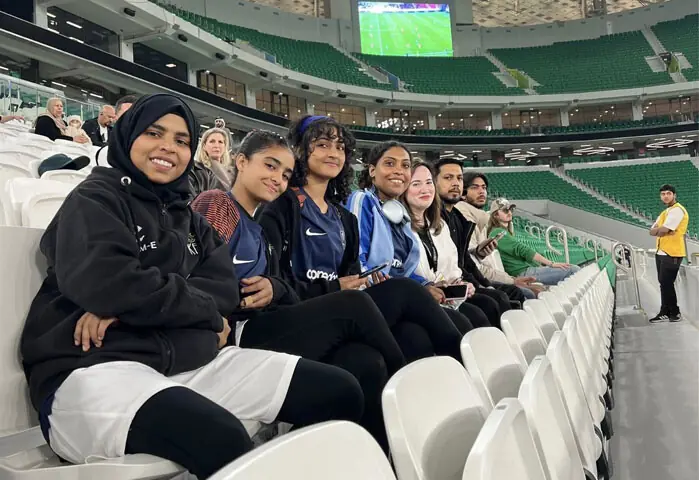
Adjusting to a new environment and intense training routines was challenging, but the players say their proudest moment came when they stepped on to the PSG training ground wearing the academy kit.
“That was the moment I realised I wasn’t only representing myself,” Zunaira says. “I was representing every girl in Lyari.”
Behind their success stands Kiran Foundation, an organisation working to create educational and sports opportunities for underprivileged communities.
According to Sabeen Naz, Head of the Empowerment and Enrichment Department at Kiran Foundation, sports are a powerful tool for personal growth.
“At Kiran Foundation, we believe sports build confidence, resilience and leadership,” she says. “This opportunity showed these girls that their talent belongs on international platforms.”
The Qatar programme was organised in collaboration with SHK Sports, the execution partner of PSG Academy. Players were selected based on their competitive experience, discipline and overall potential.
Naz believes initiatives like these can inspire an entire generation of young girls in Lyari.
“When one girl succeeds, many others begin to believe they can succeed too,” she says.
Despite the achievement, challenges for women’s football in Pakistan remain significant. Limited infrastructure, lack of funding, and cultural barriers continue to restrict opportunities for female athletes.
Coach Zubair, who trains the Kiran Foundation girls’ team, believes Pakistani players possess natural talent but lack consistent exposure.
“These girls have immense potential,” he says. “What they need are better facilities, regular competitions and international exposure.”
He points out that many female players in Pakistan rarely get access to proper football grounds, tactical analysis, or professional development programmes.
“Talent alone is not enough,” he says. “Without investment and opportunities, progress becomes difficult.”
Perhaps the most emotional perspective comes from Zunaira’s mother, who initially worried about societal pressure and her daughter’s safety.
“As a mother, you naturally worry,” she says. “People talk, and society can be harsh.”
But seeing her daughter train internationally changed everything. “Today, I truly believe girls can achieve anything with hard work and determination,” she says proudly.
For the five girls from Lyari, Qatar was not the end of the journey — it was only the beginning.
Muqaddas hopes to pursue sports science alongside football, while Zunaira dreams of playing professionally abroad before returning home to establish a football academy for girls in Lyari. Their stories present a different image of Lyari — one not defined by hardship or struggle, but by ambition, resilience and hope.
And in a community where football has long been considered only a boys’ game, five girls walked on to one of the world’s most recognised training grounds and proved that the future of football in Lyari belongs to everyone.
The writer is a sports journalist and digital
content creator. X: @Amirot7Jahan
Published in Dawn, EOS, May 31st, 2026
from Dawn - Home https://ift.tt/Cm6sfWx
Comments
Post a Comment