A local election in an industrial city in northern Italy is exposing differences over immigration between governing coalition parties and showing how the country’s rapidly changing social fabric is shaping politics.
Surrounded by factories and rice paddies, Vigevano is a city of 62,000 people where 15 per cent of the population is foreign, including many people from Egypt and Romania.
Many more are naturalised Italians and second-generation immigrants.
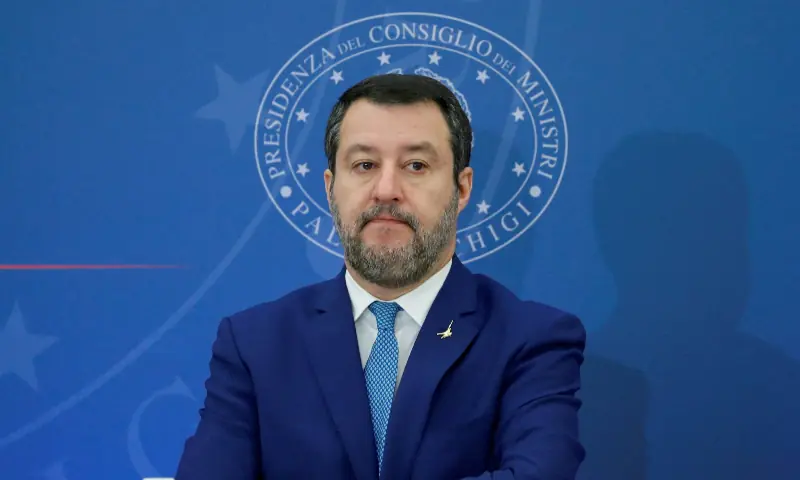
Once a Communist Party bastion, the city is held by the League, a far-right junior partner in Italy’s ruling coalition whose leader Matteo Salvini has said citizenship should be revoked for second-generation immigrants who commit crimes.
But the League’s mayoral candidate, Riccardo Ghia, a jeweller, made headlines last month when he put two Muslim candidates on his list of prospective councillors — with an eye to attracting votes from immigrant communities.
One of the two, Italian-Egyptian Hagar Haggag, 20, said she had received a slew of insults and threats since her candidacy was announced.
She attributed the virulent reaction mainly to the fact that she wears a headscarf.
She told AFP she had “never felt racism” in the local section of the party, pointing out that the former League mayor had allowed a Muslim prayer hall to open in a disused hangar in 2022.
Haggag said she was also running because she wanted to “put an end to the left-wing cliche that Muslim women are ignorant”.
She is studying diplomacy and is considering a political career beyond Vigevano — maybe even in Egypt.
The other candidate, Ibrahim Hussein, is a spokesman for the local prayer hall who presented his bid “in the name of Allah”.
Hussein wrote on Facebook that he chose to be a candidate for the League because he sees himself as “a real example of integration”.
On the last day of campaigning on Friday in Vigevano’s majestic central square, Ghia said he “does not look at whether people are Muslim or Buddhist”, adding that whoever “respects the rules is a citizen with full rights”.
Divisions between parties
Italy is gearing up for national elections next year in a country that is becoming ever more multi-ethnic and where the political clout of second-generation immigrants is growing.
The national leadership of the League said it was “distancing” itself from the candidates in Vigevano, which voted on Sunday and Monday.
But Prime Minister Giorgia Meloni’s Brothers of Italy party is supporting the candidates.
Forza Italia, another coalition partner, is more open on immigration and integration but is supporting a different mayoral list.
The divisions could be a boon for Roberto Vannacci, a former general who quit the League to set up a more radical far-right party called Futuro Nazionale (National Future).
Vannacci was in Vigevano on May 17 for a speech laden with anti-immigrant rhetoric.
The speech came a day after a young Italian man of Moroccan heritage with mental health problems rammed his car into pedestrians in the city of Modena, injuring eight people.
The local candidate supported by National Future, lawyer Furio Suvilla, says his programme is focused on security.
He has called for the army to intervene against groups of young people who gather around the station and wants the Muslim hall closed.
He said he thinks he could “pick up quite a few League voters”.
‘Still a foreigner’
Candidates with foreign origins still remain relatively rare in Italian elections, where immigration has been more recent than in France or Germany, said sociologist Maurizio Ambrosini from Milan’s Statale university.
Several right-wing parties “are trying to attract candidates with immigrant origins,” the sociologist said, adding that “many naturalised migrants tend towards the right”.
Sabrine Hamrouni, 23, a health sector worker, is also a candidate in Vigevano but for the centre-left. She said she thinks divisions on the right could help boost her campaign.
Hamrouni’s father moved from Tunisia to Vigevano in the 1990s to work in construction.
“I was born here. I have always lived here but I am still a foreigner,” the candidate said.
She said she wants to make Vigevano “a beautiful city — it will take a long time but I am willing to put in that time”.
from Dawn - Home https://ift.tt/OTz59Dx
Comments
Post a Comment