Energy expert Vaqar Zakaria believes solar power makes “excellent economic sense” — and he lives by it. For over five years, his rooftop panels have slashed his bills, sometimes to zero, even allowing him to sell surplus electricity back through net metering.
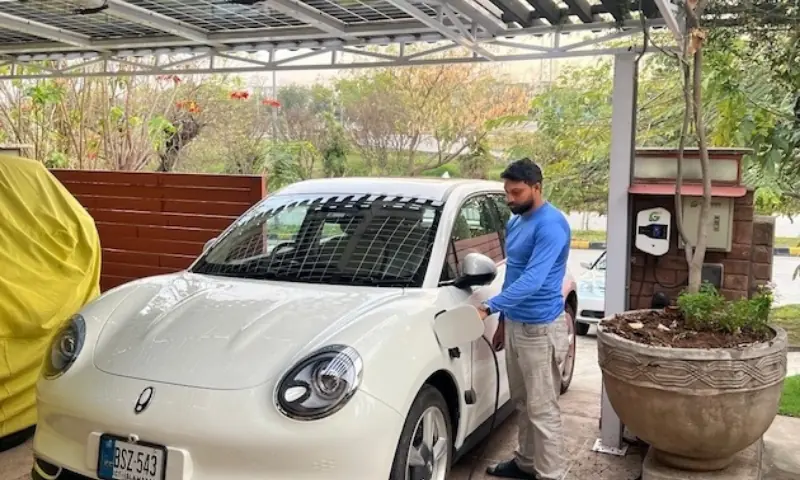
Last month, he took it further. After buying two electric vehicles, he has almost “declared independence” from the national grid. With more panels and doubled batteries, even his cars run on sunshine. “I am moving away from their fuel, and I don’t need their power,” said the CEO of Hagler Bailly, Pakistan, an Islamabad-based environmental consultancy firm, over the phone from Islamabad.
“I call it the hand of God driving my car,” Zakaria said.
He is already seeing economic gains from his investment. “The electricity I generate, including battery costs, comes to about Rs12 ($0.043) per unit, while it can be sold to the Islamabad Electric Supply Company at around Rs26 ($0.092) per unit.” However, he adds that he does not currently claim this benefit, as it requires considerable follow-up.
Doing some quick back-of-the-envelope calculations, he compared the petrol-run vehicles he used until a few months back to the EV he purchased a month ago. “The total cost of operating the EV comes to about Rs2 ($0.0071) per km using power generated at home, compared to the Rs27 ($0.096) per km I was paying earlier for running vehicles on the fossil fuel.”
This figure does not include the regular maintenance costs his earlier cars required — lubricating oils, oil and air filters, and brakes.
“An EV requires near-zero maintenance,” he added.
While Zakaria can afford a full shift off the grid, most households cannot.
“The solar landscape will remain unchanged unless power companies introduce profit-sharing models that turn consumers into ‘prosumers’ — both producers and users of energy — supported by microfinance to help cover upfront costs,” he said. Achieving this would require the privatisation of utilities.”
For now, with or without batteries, solar energy has become a popular alternative for many households. “What’s happening in Pakistan is quite significant, as electricity consumers’ dependence on the national grid is falling,” explained Rabia Babar, data manager at Renewables First, an Islamabad-based think-and-do tank for energy and environment.
Grid-based electricity demand, she pointed out, dropped 11 per cent in FY25 compared to FY22 levels, largely because more people and businesses are switching to solar.
“During the day, far less electricity is being drawn from the grid, which means gas-fired power plants are being used much less than before.”
The turning point
Haneea Isaad, an energy finance specialist at the Institute for Energy Economics and Financial Analysis, recalled the time in 2022, as the turning point when people realised they needed a cheaper alternative. “The prices of liquefied natural gas shot up after Russian forces entered Ukraine and the country faced a gas shortage, resulting in widespread power outages. Electricity prices almost tripled in just a couple of years.”
Those who could afford to, Isaad said, opted for a one-time investment in installing solar panels instead of paying for expensive and unreliable electricity.
According to EMBER, an independent clean energy think tank, solar’s share in the energy mix has risen from 2.9pc in 2020 to 32.3pc by the end of 2025.
It is this quiet solar revolution that may help ride out the current energy crisis triggered by the United States-Israel war on Iran, which led to the shutting of the Strait of Hormuz, according to a report by Renewables First and the Centre for Research on Energy and Clean Air, published earlier this week.
“Pakistan’s solar revolution is quietly redrawing the country’s energy map, cutting grid dependence, reducing LNG exposure, and building a buffer against global market shocks that most of its neighbours are yet to find,” said Babar, one of the co-authors of the report.
In fact, the report says that Pakistan has avoided over $12 billion in oil and gas imports since 2020 due to its rapid solar growth — and could save another $6.3 billion in 2026 alone at current prices.
Lead analyst Lauri Myllyvirta, co-founder of CREA, said the solar boom has cut import bills and now acts “like an insurance policy” against oil and LNG shocks from the Gulf.
Industries are also turning to solar, significantly reducing their need for LNG significantly.
“This shift has had a direct impact on government policy. Pakistan has gone back to its LNG suppliers to renegotiate long-term contracts for the diversion of surplus cargoes to international markets, which are now oversupplied due to the sharp reduction in gas consumption,” said Babar.
Pakistan has been importing LNG since 2015, after domestic reserves declined. It has been mainly used in the power sector — accounting for nearly a quarter of Pakistan’s electricity supply — followed by the industrial sector.
Supplied from Qatar via the Strait of Hormuz, LNG has become less attractive due to high prices for industry and the growing shift to solar in homes. With some LNG landing in Pakistan before the conflict began and domestic gas filling the gap from affected cargoes, supplies may be enough to last until mid-April.
“Pakistan has historically been vulnerable to volatile global LNG prices, which strain on foreign exchange reserves when prices spike,” Babar said.
Isaad agreed. “Solar has provided a buffer. With the power sector also relying on coal imports from Indonesia and South Africa, supply pressures are unlikely to pose a problem in the near term. Seasonal hydropower and mild weather are also likely to prevent an immediate spike in LNG based power demand. For now, Pakistan has been spared — unlike Bangladesh and India, which have been hit the hardest in South Asia.”
Not out of the woods yet
But the solar panels have not shielded Pakistanis from the rising oil prices. The country saw a 20pc jump — the highest in its history — with petrol and diesel costing Rs321.17 ($1.15) and Rs335.86 ($1.20) per litre, respectively. As transport drives the economy, higher oil prices quickly pushed up fares and the cost of groceries.
In response, Zakaria said the crisis highlights a clear path forward: embrace EVs, reduce diesel dependence, and expand renewables. “Begin with two-wheelers,” he suggested, though a full EV mass transit system would be ideal for Pakistan. He added that shifting freight from trucks to rail could significantly cut fuel costs.
He said he supports the oil rationing and austerity measures taken by the government.
Last week, addressing the nation, Prime Minister Shehbaz Sharif announced these measures on television.
“The entire region is currently in a state of war,” he said, outlining steps, including a four-day workweek for government employees and spring holidays for schools from March 16 to the end of the month. He also said 50pc of government staff would work from home on a rotating basis and recommended similar arrangements for the private sector.
Higher education institutions have shifted to online classes to save fuel, as have meetings across federal and provincial governments. Fuel allowances for government offices have also been reduced.
Under the government’s austerity measures, federal and provincial cabinet members will forgo two months’ salaries and allowances, while lawmakers’ pay will be reduced by 25pc. Ministers, parliamentarians, and officials may travel abroad only when essential — and must fly economy. Weddings will be capped at 200 guests, served with a single-dish meal.
The human cost
But these measures have brought little relief to Saba Nasreen’s household finances. The 52-year-old mother of two, who works as a domestic help, said, “Rising fuel prices have literally crippled us; when fuel costs go up, food prices follow. We hardly buy fruit or meat; now even milk and vegetables are beyond our range,” she said.
With Eid ul-Fitr — the Muslim festival marking the end of Ramadan — just days away, she said, “This will be the first Eid in as long as I can remember that I won’t be making sheer khurma for my daughters,” referring to the traditional sweet vermicelli dish prepared in many Muslim households across the subcontinent. “The price of a box of vermicelli has doubled this year, from Rs 150 ($0.53) to Rs 300 ($1.07),” she said, adding, “In any case, the attack on Iran has already dimmed our festivities; I’m not happy inside, my heart feels heavy.”
For many, the solar revolution offers hope — but for households like Nasreen’s, the struggle continues.
This article was originally published in Inter Press Service and has been reproduced here with permission.
Header image: The Sindh government has started distributing solar home systems to 200,000 low-income households under the Sindh Solar Energy Project to improve electricity access. Credit: Sindh People’s Housing for Flood Affectees
from Dawn - Home https://ift.tt/UyNgIY3
Comments
Post a Comment