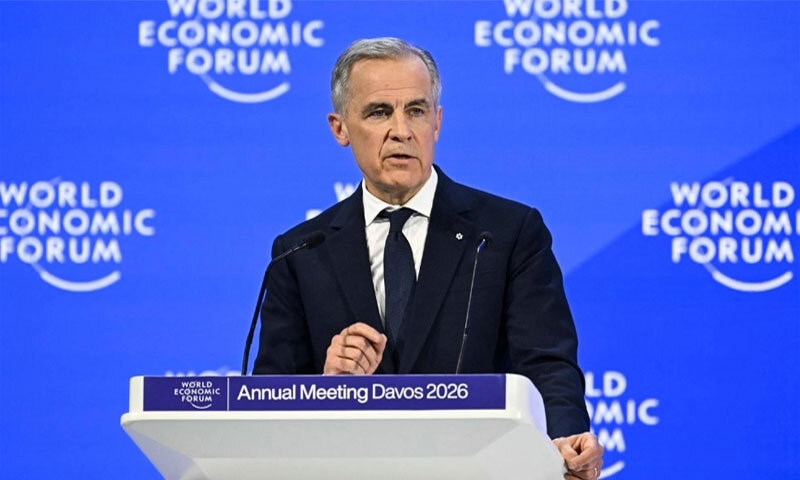
“This bargain no longer works. Let me be direct. We are in the midst of a rupture, not a transition… You cannot live within the lie of mutual benefit through integration, when integration becomes the source of your subordination.”
— Mark Carney, Prime Minister of Canada, at Davos 2026
“After the war, we gave Greenland back to Denmark. How stupid were we to do that? But we did it, but we gave it back. But how ungrateful are they now? And then after the war, which we won, we won it big — without us, right now, you’d all be speaking German and a little Japanese, perhaps.”
— Donald Trump, US President, at Davos 2026
“If anyone thinks that the European Union, or Europe as a whole, can defend itself without the US, keep on dreaming. You can’t. We can’t.”
— Mark Rutte, Secretary-General Nato, speaking at EU Parliament
Canada’s Prime Minister Mark Carney went to the World Economic Forum at Davos and told the world that his country — by extrapolation, all US allies — had lived a “pleasant fiction” that is now over. That fiction was grounded in the assumption that the United States would continue to lead a global order and that such order would perpetually guarantee stability, provide limitless liquidity, and manage all systemic risks. Under this global order, American hegemony would continue to “provide public goods, open sea lanes, a stable financial system, collective security and support for frameworks for resolving disputes.” This does not obtain anymore.
For decades, America’s Western allies lived comfortably with a system in which the US was the accepted hegemon and which benefitted them as its satraps. That system is now unravelling because of the brazenness and boorishness of US President Donald Trump and because the allies are now being treated like others were always treated in the Global South. For the first time, Canada and Europe are being forced to confront the fact that power creates its own dynamics…
This is where the irony lies. For Carney, as also other US allies, US hegemony worked and made them prosper as long as its application of force targeted states and societies in what we loosely describe as the Global South: Latin America, Africa, the Middle East, to name just the most obvious regions. These are also the regions where a number of states or leaders within those states decided to remove the signboard, to not live the lie that Canada was so content to live with until recently and acquiesced in.
Those leaders were picked off — the list is long from Mohamed Mosaddegh to Patrice Lumumba to Ngo Din Diem to Salvador Allende to hundreds of failed attempts on Fidel Castro — those states suffered and most, like Iran, continue to suffer. The system’s power did not come from its truth, but from Canada’s willingness, as also of other US allies, to perform as if it were true. Now, “its fragility comes from the same source”, as identified by Carney.
I argue that the challenge faced by the US allies is not that the United States has suddenly become more of a hegemon. The entire post-WWII system was grounded in unequal power distribution and accepted hegemony of the US by its allies. The fiction Carney spoke about was (and remains) an elaborate mise en scène, put together not just by the US but also its allies. In fact, as we shall discuss later, the centrality of a dominant power is the core tenet of an integrated alliance system that must also have a unifying perception of threat and shared values.
Carney’s assertion that “when we only negotiate bilaterally with a hegemon, we negotiate from weakness”, and his invocation of Thucydides’ Melian Dialogue are, therefore, about the direction of the exercise of US hegemony, not hegemony itself. What is true, however, is the fact and Carney’s realisation of it, that a hegemon’s intent can change. That is what has happened.
To that end, I propose to briefly look at how the North Atlantic Treaty Organisation (Nato) came about and what exactly is the Greenland issue about. Finally, I argue that, while this moment may not be a Wagnerian frenzy, it could lead to that in the years to come, quite possibly unravelling Europe, which is not a single, seamless entity but a conglomeration of multiple states and ethnolinguistic groupings.
EUROPE, AMERICA AND NATO: FROM RELUCTANCE TO PRIMACY
What follows is based on a number of works, including those by US international affairs academic Lawrence Kaplan, Canadian diplomat Escott Reid and US historian Melvyn Leffler and several declassified documents from the Foreign Relations of the United States (FRUS) volumes.
Today, Nato is taken for granted. But the idea and its actualisation did not evolve as a premeditated American design. It emerged from European insecurity, economic and military, and involved a drawn-out and complex diplomatic process. The US was still grappling with its new global role and was reluctant to get involved in Europe’s affairs again. The Joint Chiefs of Staff and National Policy Volume II 1947-1949 by military historian Kenneth Condit makes clear that post-war demobilisation had left the US military (all branches) starved of manpower and materiel.
A good example of such pressures was the crisis in Greece (Civil War 1946-49) and the decision by Britain to withdraw its troops from there in 1947. The US wanted the British to keep the troops in Greece, even as the JCS’s own study had concluded that “the United States was not capable of deploying sufficient armed forces to Greece to defeat a combined attack by Yugoslavia, Albania and Bulgaria. Any US force sent should therefore be small. It should be solely for the purposes of stiffening morale of the Greeks and of contributing to stability in areas where it was stationed.”
The details are too many and complicated. The essential point, however, is that the period from December 1947 to March 1948 marked the critical point where the idea of a transatlantic military pact moved from a British proposal to an accepted, if still vague, American objective.
On December 17, 1947, British foreign secretary Ernest Bevin made a case to the US Secretary of State George Marshall for a “Western Union.” Bevin’s concept, which he described as a “spiritual federation of the West”, encompassed Western European nations, the British dominions and, crucially, the United States. This entity would be “an understanding backed by power, money and resolute action”, with its essential task being to create a “feeling of security” and the confidence that “further communist inroads [into Eastern Europe] would be stopped.” The US presence in the Union would provide Europe the confidence to resist the Soviet political threat.
While agreeing with the general idea and its importance, Marshall struck a cautious tone. He believed the union should be purely European, with the US providing only material assistance. He refused to approve any specific course of action or make public promises. This was in line with the Truman administration’s reluctance to undertake formal military commitments despite the March 1947 Truman Doctrine, which pledged American political, military and economic aid to democratic nations under threat from authoritarian (specifically communist) forces.
Bevin elaborated his proposal in a formal paper in January 1948. He argued for a union, formal or informal, that included Scandinavia, the Low Countries, France, Italy, Greece, Portugal and, eventually, Spain and Germany. As a first step, he proposed expanding the 1947 Dunkirk Treaty — a bilateral Anglo-French pact solely against future German aggression — into a treaty with the Benelux countries. This “solid core” could then expand into the full Western Union. Bevin’s proposals at this stage were far ahead of American thinking. Marshall or his aides had not seriously considered a military alliance with the Europeans, despite the emerging Soviet threat.
The British initiative did spark a debate within the US State Department. Two distinct camps emerged. One comprised the sceptics, led by Marshall, Under Secretary Robert Lovett and George Kennan, head of the Policy Planning Staff and the writer of the famous ‘Long Telegram’ and the ‘X Article’, which analysed Soviet ideology and advocated containment. Kennan welcomed the idea of a European union under Franco-British leadership, believing it could restore the balance of power.
However, he opposed direct US military commitment, arguing that a military pact should flow from political and economic union, not precede it. He also warned that using the anti-German Dunkirk Treaty as a model was “a poor way” to prepare for Germany’s eventual inclusion. Like Marshall, Kennan insisted the initiative and hard work must come from Europe itself. When that happened, the US could then offer support.
The other camp had advocates of an Atlantic pact, primarily John D. Hickerson, director of the Office of European Affairs, and his deputy Theodore Achilles. Hickerson agreed the Dunkirk model was flawed but argued that a European union backed only by US aid would be insufficient. He believed only a direct American moral commitment — a promise to fight if necessary — could generate the “confidence and energy” needed to restore a stable, solvent Europe. He proposed modelling a new pact on the Inter-American Treaty of Reciprocal Assistance (the Rio Treaty), which would be linked to the UN Charter. This “Atlantic security system” would explicitly include the US and Canada alongside the Western European states.
Initially, the sceptics held sway. On January 20, 1948, Marshall informed the British ambassador that the US welcomed Bevin’s initiative and would assist it “to the fullest” but would not be a part of it. This marginalised Hickerson and Achilles. Marshall’s position was rooted in several powerful strands of opposition within the US government, the Congress and the military. From a strategic perspective, Kennan et al viewed the Soviet threat in early 1948 as primarily politico-economic, not military. The preferred instrument to counter the Soviets was the European Recovery Program (ERP, or Marshall Plan).
They feared that a sudden push for a military alliance could jeopardise Congressional approval of this vital economic aid package. They were also hedging politically and anticipated resistance from three quarters: traditional isolationists who opposed entangling alliances because they drained US resources; internationalists who saw such a pact as undermining the United Nations; and the military establishment, which did not have the capacity for unsustainable commitments and wanted to withdraw troops from an indefensible Western Europe. Secretary of Defence James Forrestal warned of the danger of letting military commitments outpace capabilities.
Faced with American reluctance, Bevin and French foreign minister Georges Bidault decided Europe must take the first step, hoping to ‘lure’ the US in later. On March 17, 1948, Britain, France and the Benelux countries signed the Brussels Treaty, establishing the Western Union. This coincided with a shift in American opinion, catalysed by an escalation of Cold War tensions in February and March 1948.
The Soviet-backed communist coup in Czechoslovakia in February, combined with Soviet pressure on Finland and Norway and intensified communist agitation in Italy and France, ignited a palpable ‘war-scare’ in Washington. This climate of crisis helped remove key barriers to American action. While US leaders still did not believe that war was imminent, they now concluded that economic aid alone was insufficient to provide the psychological stability needed for recovery. Only a US security guarantee could create the necessary confidence to resist Soviet political subversion.
On March 11, Bevin formally invited the US to discuss a North Atlantic treaty. The following day, Marshall agreed to proceed with joint talks on an “Atlantic security system.” In a speech to Congress on March 17, the very day the Brussels Treaty was signed, President Truman endorsed the pact and pledged that the US would “extend to the free nations the support that the situation requires.”
By late March 1948, the fundamental US position on a transatlantic security pact had reversed. The objective was now to design a form of military commitment to Europe. The consensus purpose was not to prepare for a likely Soviet invasion, but to “strengthen the determination of the free nations to resist… Soviet-directed world Communism” and “increase their confidence.”
The commitment would serve as a psychological and political stabiliser to ensure the success of the Marshall Plan. The remaining debates were to be worked out in the subsequent Pentagon Talks. The path to Nato had opened up, forged by European fear, British diplomacy, and an American realisation that economic power required a security complement to be effective in the upcoming Cold War.
But there was something else too. If this were to work, the alliance needed a dominant state. That state was to be the US. The path was also cleared from reluctance to configuring Nato with the US at the apex.
Despite belonging to different theoretical schools, John Mearsheimer, John Ikenberry and Melvyn Leffler converge on this point: US hegemony in Nato was not an accidental outcome but a logical result of the alliance’s foundational conditions and strategic purpose. Once committed, the US used its unmatched power to shape Nato’s institutions in ways that locked in its leadership, ensuring the alliance would remain an extension of American grand strategy, while providing Europe with indispensable security.
This ‘bargain’ — European subordination to and participation in the American-led financial and security architecture for American protection — was the stable, if unequal, core of the transatlantic relationship for decades. The post-Cold War evolution — with Nato expanding eastward under continued US impetus, and recent developments about Nato’s future and the US role — further demonstrate the nature and extent of this configured hegemony.
This structural imperative (predominance of US power — economic, industrial, human resource, military, technological) was wedded to Nato’s strategic logic and influenced Nato’s institutional design both politically and operationally. The Europeans, since the end of the Cold War — the so-called peace dividend — have become niche auxiliaries. Budgets were slashed, conscription abolished, personnel reduced. It has been the same story regarding capabilities and inventories.
This is precisely what Trump began talking about in his first term. While the Russo-Ukraine War and slacking US commitment to Europe have forced a rethink, it will take at least a decade-and-half’s sustained effort for Europe to develop the strategic capabilities for which they entirely rely on the US. This is the reason Mark Rutte bluntly told the EU parliamentarians that Europe can’t defend itself without the US.
We shall return to this issue of US hegemony but let’s first get to Greenland.
GREENLAND, JUST TRUMP’S OBSESSION?
Short answer, no. Let’s go for the longish answer. The US has a history with Greenland. In recent years, melting Arctic glaciers and warming waters, as also Russia and China’s interest in the Arctic waterways, have revived the conversation among US policymakers. But it’s also the geography.
As Marc Jacobsen, an associate professor at the Royal Danish Defence College, told the BBC, “If Russia were to send missiles towards the US, the shortest route for nuclear weapons would be via the North Pole and Greenland. That’s why the Pituffik [pronounced bee-doo-feek] Space Base is immensely important in defending the US.”
When Nazi forces occupied Denmark during World War II, the US invaded Greenland and established military and listening posts on the island. The Danish Ambassador to the US during World War II was Henrik Kauffmann, a pivotal figure who, after Germany occupied Denmark in 1940, acted independently as the representative of “Free Denmark” and signed crucial defence agreements for Greenland with the US. On April 9, 1941, he signed an agreement with the US allowing American military bases in Greenland, a critical move to prevent German seizure of the island.
After the war, the US expanded the Pittufik Space Base, formerly known as Thule Air Base. A 1951 defence agreement with Denmark also granted the US a significant role in the defence of the territory, including the right to build and maintain military bases.
But before the 1951 agreement, in 1946, the US expressed the desire to purchase Greenland from Denmark for a sum of $100 million in gold bars. US officials at the time described the interest in Greenland as a “military necessity”, precisely the language used by Trump when he suddenly mentioned Greenland.
The 1946 offer remained classified until documents were declassified in 1991. But it wasn’t the first time the US had shown interest in Greenland, though. US Secretary of State William Seward raised the idea of annexing it along with Iceland in 1867. Seward had earlier purchased Alaska from Russia in March of the same year. Trump himself talked about buying Greenland in 2019. A Wall Street Journal report at the time revealed the plan. All these offers have been rebuffed by Denmark.
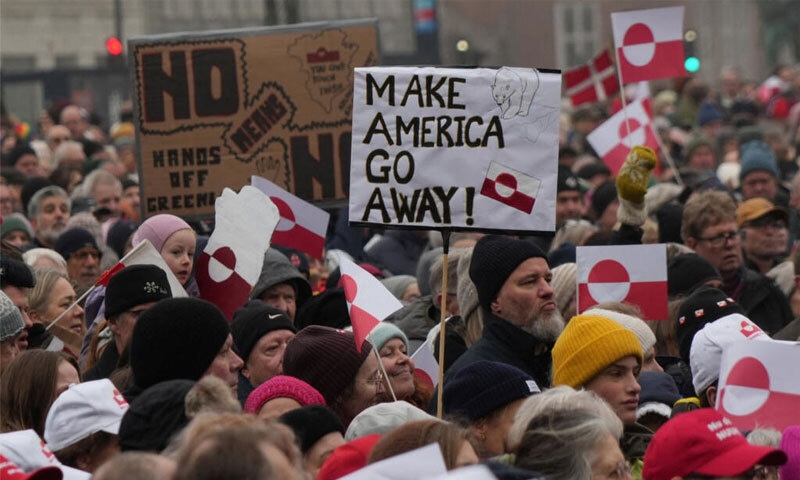
In January this year, Trump stated that “the fact that they [Danes] had a boat land there 500 years ago [sic] doesn’t mean that they own the land.” So what’s the legal status of Greenland?
The 1933 Eastern Greenland Case before the Permanent Court of International Justice (PCIJ) centred on a sovereignty dispute between Denmark and Norway. In 1931, Norway occupied and claimed a portion of Eastern Greenland, arguing it was terra nullius [unowned land] outside Danish control. Denmark countered that its sovereignty historically extended over all of Greenland, supported by continuous and peaceful displays of authority, such as a trade monopoly and granting of concessions. A key diplomatic point was the 1919 Ihlen Declaration, where Norway’s foreign minister had informally assured Denmark that Norway would not challenge Danish sovereignty over Greenland.
The PCIJ ruled 12-2 in favour of Denmark by arguing that Denmark had demonstrated sufficient intention and exercise of sovereignty to claim title over all of Greenland. The Court also held that Norway was bound by the Ihlen Declaration and thus obligated not to contest Danish sovereignty or occupy any part of Greenland.
The case remains a significant precedent in international law, particularly regarding territorial acquisition, the binding nature of unilateral declarations by state officials, and the requirements for effective occupation even in sparsely populated areas (contrast this with Occupied Palestine). That said, the ruling was a product of a colonial era.
Today, the right to self-determination of Indigenous peoples, such as the Inuit of Greenland, would be a central consideration, fundamentally altering the legal context for such disputes. In essence, this means, legally speaking, that any decision about Greenland must come from the Greenlanders and no one else. They have already rebuffed Trump’s desire to take control of the island.
But the issue for our purpose is different. Just to recap, my argument is that US hegemony was built into the post-WWII alliance system. So what was the fiction?
THE PREDICTABLE FICTION
US allies, including Canada, were perfectly fine with the yarn woven by a benign hegemon. As Carney himself noted, it was a predictable system, despite being fictitious. But no one cared because it allowed Canada and Europe to play along, act bigger than they were and are, get prosperous and be protected. For the US too, it was a win-win. Nato is a force multiplier for the US military power and it also provides legitimacy to American power projection.
As noted above, the Europeans bring niche capabilities and diplomatic support. Freedom from bearing the full cost of defence, they could focus on economic growth and industrialisation and punched above their weight because of the US backing. In that, they were and are also willing partners in bullying states the US wants to sanction and beat up.
Like the child in Ursula Le Guin’s story, The Ones Who Walk Away from Omelas, the town’s (read US allies’) happiness requires the child’s misery. In the real world, that child can be found in many parts of the world: occupied Palestine, Syria, Lebanon, Libya, Iraq, Iran, Venezuela… the list is long.
To be precise, Carney et al don’t want to walk away from Omelas. They aren’t particularly concerned about the misery of the child in the basement of a building. Or to use Carney’s invocation of Vaclav Havel’s green grocer, they don’t want to remove the sign.
In the Q&A at Davos after his speech, Carney was far more circumspect, especially when asked about Greenland and Nato. Their concern is how ‘Daddy’ is behaving, mocking them for what the allies really are: subordinates — children who hold cushy jobs in the global US enterprise but must behave if they are to retain their houses and cars and yachts and place on the board.
Those, like Iran, who never signed up to the signboard, belong to a different story — the real, sordid one, not the pleasant fiction. None of the US allies is prepared to speak the truth on Iran — at least not for some time to come.
But something else has also happened. And that has the allies running helter-skelter. In this fiction there was (and is) one big reality: US preponderance. What if the sudden malignancy of hegemony becomes a practice? While the fiction lasted, no one thought about it.
The fact that allies were satraps was only occasionally put on overt display: Suez (Britain/France); Nixon Shock (devastating currency reserves of allies, especially Japan); Kissinger’s 1973 exhortation to allies that they subordinate their regional interests to US global leadership; 1973 oil shock; extraterritorial bullying through the Helms-Burton Act 1996; Old Europe/New Europe statements during the illegal invasion of Iraq.
With Trump, it’s more brazen and boorish. If the US is the dominant power and if allies expect it to protect them, why can’t it make some demands? Oh, there’s a bit of a problem. It’s called a rules-based order. Really, thinks Trump. Didn’t I just abduct a head of state? What are these Europeans talking about. They were fine with it.
Wait, the rules-based part of the fiction had some reality within the camp. You didn’t pee inside the tent. Now the camp is being treated the same way as others. That sucks. Even if Trump were to be an aberration 2.0, the historical rule has been established. Power creates its own dynamics.
That’s the rupture Carney has pointed to. The question is, can Canada, in collaboration with Europe, develop an alternative power pole? Contiguity works against Canada; distance works against Europe. Trump is not the only thing happening to Europe. There are other strands and pressures within Europe that will likely determine Europe’s future and whether and for how long one could use a collective noun for Europe.
In October 2022, during the inauguration of the European Diplomatic Academy in Bruges, Josep Borrell, EU’s High Representative for Foreign Affairs and Security Policy stated: “Europe is a garden. Most of the rest of the world is a jungle and the jungle could invade the garden.” It’s kind of ironic!
The serpent is already in the garden and going by the Book of Genesis, he is an irrevocable part of the story of Man.
The writer is a journalist interested in security and foreign policies. X: @ejazhaider
Published in Dawn, EOS, February 8th, 2026
from Dawn - Home https://ift.tt/YBa0hRE
Comments
Post a Comment